

UAE weather: Highest temperature this year recorded at 51.2°C despite rain, thunderstorms
Convective clouds to bring more wet weather through Friday

DUBAI – The United Arab Emirates (UAE) witnessed one of the most striking weather contrasts of the summer on Wednesday, with the country's highest temperature of the year recorded even as heavy rain drenched parts of the eastern and western regions.
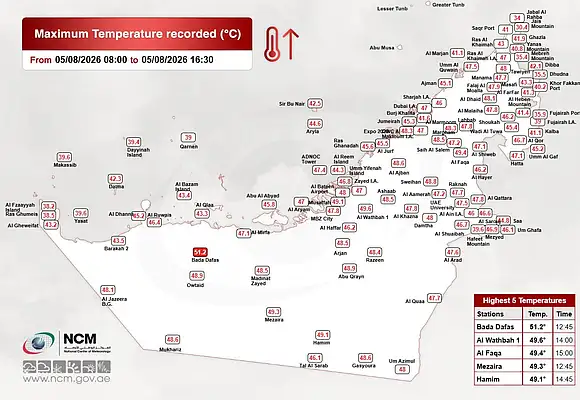
While thermometers climbed above 51°C in Al Dhafra, showers swept across Fujairah and parts of the Dhafra region as unstable weather continued to develop. Authorities expect similar conditions to persist over the next two days, with further cloud formation and rainfall possible.
الإمارات : الان هطول أمطار الخير على شرع الشيخ خليفة المؤدي الى الفجيرة #أخبار_الإمارات #مركز_العاصفة
— مركز العاصفة (@Storm_centre) August 5, 2026
5/8/2026 pic.twitter.com/MWMEcZgIvi
The National Centre of Meteorology (NCM) said the highest temperature recorded in the country on August 5 reached 51.2°C in Budu Dafs, Al Dhafra, at 12.45pm UAE time. The previous highest reading this summer was 50°C, recorded in Al Shawamekh, Abu Dhabi, on August 1.
Record heat
The latest reading marks the hottest temperature recorded in the UAE so far this year, highlighting the intensity of the country's peak summer season. The period known locally as Jamrat Al Qayth, or the embers of summer, is expected to continue until August 10 before temperatures gradually begin transitioning towards the next seasonal phase.
Astronomers have also noted the recent appearance of Al Mirzam, also known as Sirius, above the eastern horizon. Traditionally, its rise signals the final stage of the UAE's most intense summer heat.
Rain returns
Despite the extreme temperatures, rain continued to affect several parts of the country. Weather-tracking platform Storm Centre shared videos showing rainfall along Sheikh Khalifa Road leading to Fujairah, while stormwater flowed through wadis in the emirate. Separate updates also showed showers over Bani Zayed prayer grounds in the Dhafra region.
الإمارات : الان هطول أمطار الخير على بدع زايد في منطقة الظفرة #أخبار_الإمارات #مركز_العاصفة
— مركز العاصفة (@Storm_centre) August 5, 2026
5/8/2026 pic.twitter.com/Nr1H82evQO
The rainfall comes as atmospheric conditions remain favourable for the formation of convective clouds across the UAE.
Cloud formation
According to the NCM, unstable weather is expected to continue until Friday, August 7, with convective clouds likely to develop over different parts of the country, bringing further chances of rainfall.
The weather authority explained that although intense summer heat creates strong surface heating that helps convective clouds form, heat alone does not produce rain. Moisture, humid air masses, atmospheric instability, upper-air troughs and favourable wind conditions must also combine before thunderstorms and rainfall can develop.
Cloud seeding
The NCM also confirmed that cloud-seeding operations were carried out whenever suitable clouds were identified during the previous spell of unstable weather. The programme aims to enhance rainfall opportunities when atmospheric conditions are favourable, even during periods when temperatures approach the 50°C mark.